
Introduction
The right material and adhesive selection determine a label’s performance in the field. No matter how good the print is, choices that do not match the surface and environment can quickly lead to peeling, tearing, or unreadable labels. Therefore, the selection process should be evaluated together with the “product + surface + environment” combination.
Quick Decision Checklist
- Is the surface where the label will be applied clearly identified?
- Are the environmental conditions (indoor/outdoor, temperature, and humidity) defined?
- Will there be friction or chemical exposure?
- Has the expected label lifespan (e.g., 1 week / 1 year) been determined?
- Is the application method (manual / automated labeling) clearly defined?
Material Types and Differences
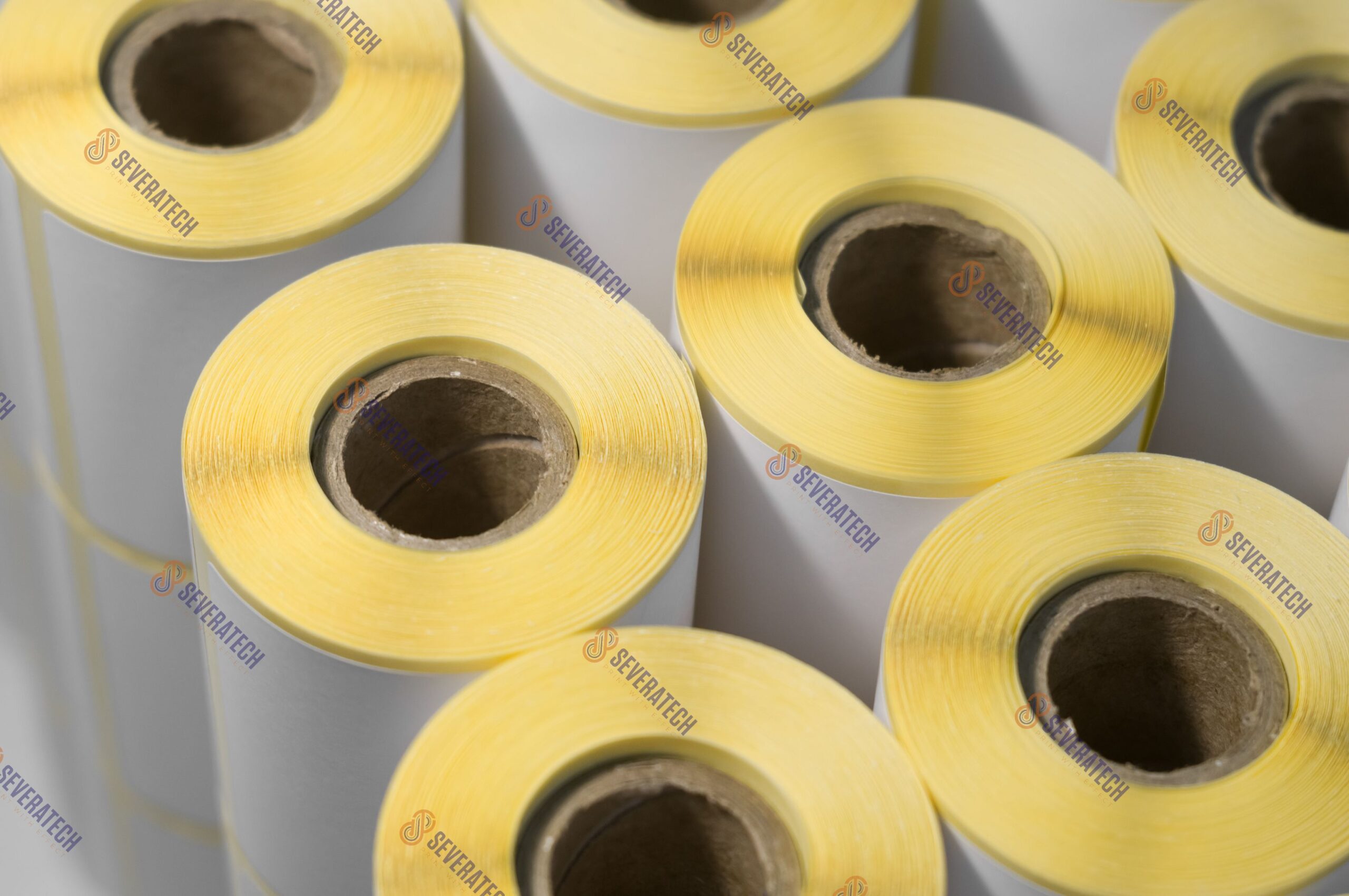
Paper materials are cost-effective and offer good print quality but are more sensitive to water and humidity. Thermal labels (direct thermal) allow ribbon-free printing but carry a risk of fading over time when exposed to heat or light. Film materials such as PP, PE, and PVC are more resistant to water, tearing, and environmental conditions, making them especially suitable for logistics and industrial applications.
Matte surfaces can reduce glare and improve barcode readability, while glossy surfaces appear more visually vibrant but carry a risk of reflection. Protective layers such as lamination or varnish strengthen the print; however, if chosen incorrectly, they can reduce barcode performance.
The label’s shape (curved surfaces, small diameters, or tight spaces) determines the required flexibility of the material. The final choice must be compatible with both the printing technique and the application conditions.
Choosing a film material alone is not enough; even the most durable film will cause problems in the field if it is not compatible with the application surface and environmental conditions.
What Do Adhesive Types Indicate?
Acrylic adhesives provide balanced performance for general use and offer good resistance to aging. Hotmelt adhesives stand out in applications that require quick adhesion due to their strong initial tack.
Removable adhesives are suitable for applications where labels need to be removed without leaving residue. Low-temperature (cold) adhesives are preferred to prevent weak initial adhesion in cold storage environments. Special formulations may be required for plastics with low surface energy.
Surface and Environment
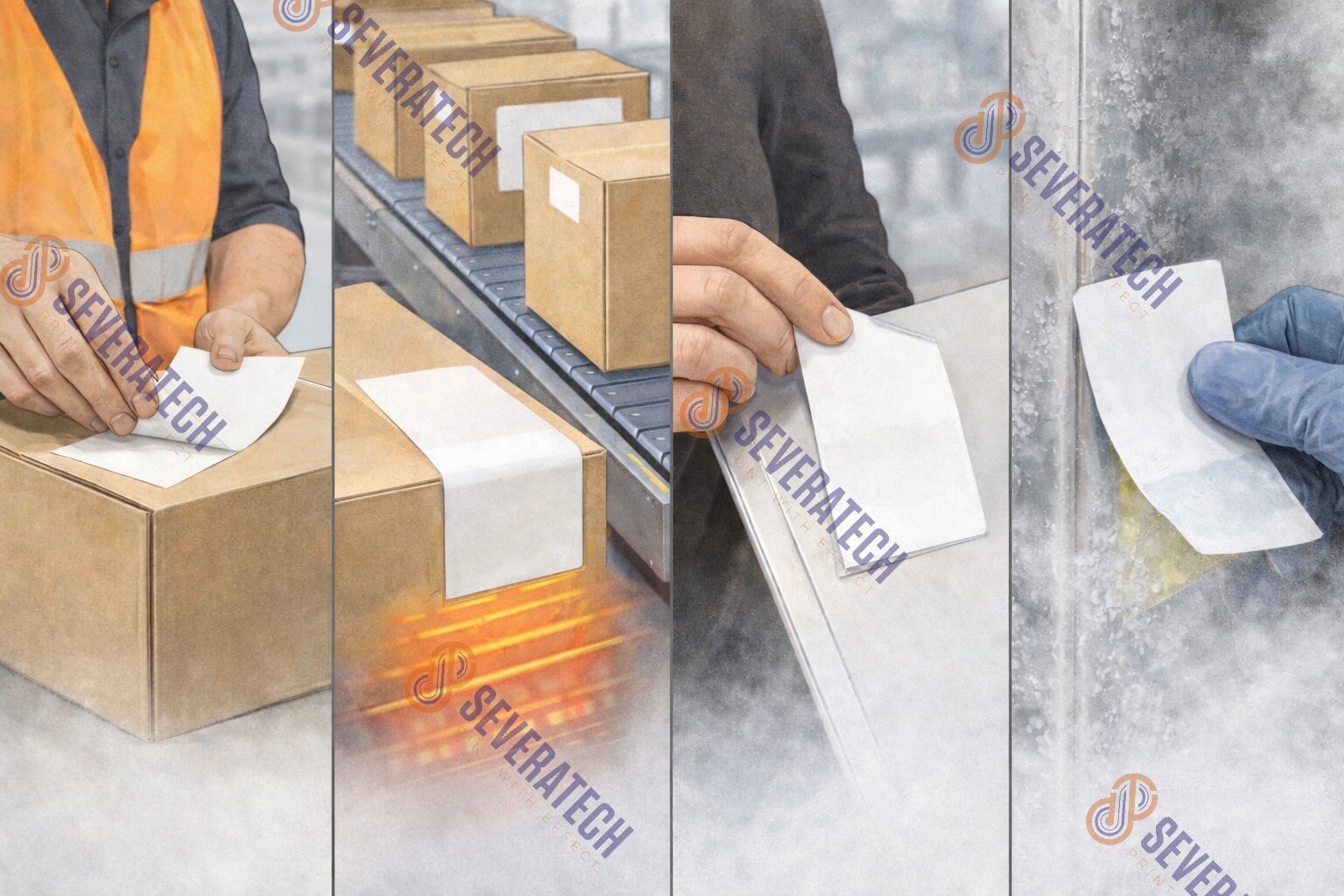
On dusty or oily surfaces, label adhesion becomes more difficult, making surface preparation critical. Humidity, steam, and water contact can cause warping or lifting on paper materials. Outdoor exposure to UV and temperature fluctuations stresses both the material and the adhesive; without the right combination, labels can become brittle. Chemical contact (alcohol, solvents, cleaning agents) can erase prints and weaken the adhesive. On curved surfaces, rigid materials may wrinkle, whereas more flexible films provide more stable results. As application speed increases (e.g., in automated labeling), the adhesive’s initial tack performance becomes increasingly important.
The factor that most determines a label’s lifespan is not the print itself but the surface + environment compatibility. When uncertain, the safest approach is to perform a small pilot application and check it after 24 hours.
Print Compatibility
The material you choose must be compatible with the printing technique and ribbon type. Wax ribbons offer a cost-effective solution on paper but have limited resistance to abrasion. Wax-resin provides more balanced durability and is a reliable choice for many applications.
Resin ise film malzemelerde yüksek dayanım verir; kimyasal ve sürtünme direnci gereken işlerde öne çıkar. Yanlış ribon seçimi, etiket sahaya çıkmadan “silinme” şikâyeti doğurabilir.
Proper Testing
The best choice is confirmed through a short test that simulates real usage conditions. Differences in adhesion across various surfaces (cardboard, plastic, metal, glass) can be easily observed. Simple but highly instructive tests include abrasion testing (rubbing by hand), chemical exposure simulation (wiping), and temperature cycling (hot/cold exposure).
For barcode jobs, post-application test scans should be performed using multiple devices. These tests reduce the risk of returns and help establish a clear production standard.
The safest approach is to finalize the selection based on a practical application test rather than relying solely on the catalog.
Summary
Material and adhesive selection form the foundation of a label’s real-world performance. For the right decision, the surface, environment, and expected label lifespan must be clearly defined from the start.
Next, the material type, adhesive type, and print compatibility should be evaluated together. In any uncertain case, a small pilot test prevents major costs.